
Organist Paul Jacobs Talks the Tricks of His Trade
David Lewellen
PUBLISHED
Tagged Under: 2025.26 Season, Classics, Guest Artist, Organ
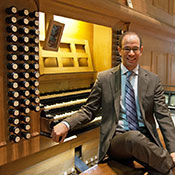
When Paul Jacobs sits down at a new organ, he has a lot of work to do.
Jacobs, a busy organ soloist and recitalist, will perform with the Milwaukee Symphony Orchestra on Feb. 6-7. It is his first appearance with the MSO, and every spare moment he has will be spent learning the possibilities of the symphony’s organ.
“An organist has to be more adaptable than any other instrumentalist,” Jacobs said recently by phone. “They vary so dramatically from one to the next. Every Steinway has 88 keys, and they’re the same size, and you know where everything is.” That is not true for the manuals, registers, and stops of an organ, and Jacobs said, “I spend many hours finding the best sounds for a given piece.”
In Milwaukee, Jacobs will perform Saint-Saëns’s Symphony No. 3, nicknamed the “Organ” symphony. It is probably the most famous piece in the repertoire for organ and orchestra, although the organ only plays in two of the four movements — but everyone remembers the magnificent wall of sound in the finale.
In the soft second movement, “Saint-Saëns brings the organ in the back door, and it purrs and caresses the strings,” Jacobs said. “And then eventually he opens the floodgates.”
The first half of the concert will feature Jacobs performing Samuel Barber’s Toccata Festiva with the orchestra. “I never get tired of playing the Saint-Saëns,” he said, “but I hope the audience will experience the full range of what’s possible. The Barber is a more complete experience. It shows off the organ in all its glory.”
It is not much of a spoiler to report that Jacobs has prepared an encore by J.S. Bach, the composer more firmly associated with organ music than any other. “Bach affects all later composers,” he said. “Organists and audiences alike derive as much pleasure from him now as they did hundreds of years ago.”
The MSO has not yet raised the money to build a state-of-the-art pipe organ in the Bradley Symphony Center, so Jacobs will perform on a digital instrument. But he will still have to go through the same process of trying combinations of stops and settings to make the music sound its best in the hall.
“I hope Milwaukee is able to pull everything together and get a fine organ,” Jacobs said —but he noted that the New York Philharmonic also lacks a pipe organ, despite the lobbying of former music director Kurt Masur (father of Milwaukee’s Ken-David Masur). A digital organ, “if it’s well-installed and well-voiced, can certainly do the job,” Jacobs said. “And it’s important to experience this great repertoire.”
He says he is one of a relative handful of organists who perform regularly with orchestras, but he holds the distinction of being the only organist to win a Grammy — Best Instrumental Soloist Performance (without Orchestra) in 2011, for a disk of works by Messiaen.
Jacobs grew up in the small town of Washington, Pennsylvania, and began playing the organ “as soon as I was tall enough to reach the pedals.” He was fortunate to have excellent mentors, and by his mid-teens he had a weekly job as a church organist.
His days of playing Sunday morning services are long behind him, but the experience taught him how to work with all kinds of people — “some very sophisticated, some very opinionated, some quiet, but you have to value everyone and respect everyone.”
He still gives recitals in churches on a regular basis — his previous trip to Milwaukee was to perform at Church of the Gesu on the Marquette University campus, which he remembers as “a great organ and a great acoustic.” Church organs and orchestral organs are built for different purposes, he said, and churches tend to be much more reverberant than concert halls.
Whatever the setting, he said, “I hope people are open to the grandeur and beauty of the organ in both sacred and secular environments.”