Behind the Scenes with Bach: Cheryl Frazes Hill Prepares the Chorus for Bach’s Drama
David Lewellen
PUBLISHED
Tagged Under: 2025.26 Season, Chorus, Classics, MSO Notable
Cheryl Frazes Hill has been working for almost a year to prepare the Milwaukee Symphony Chorus to tell the story of Jesus’s crucifixion.
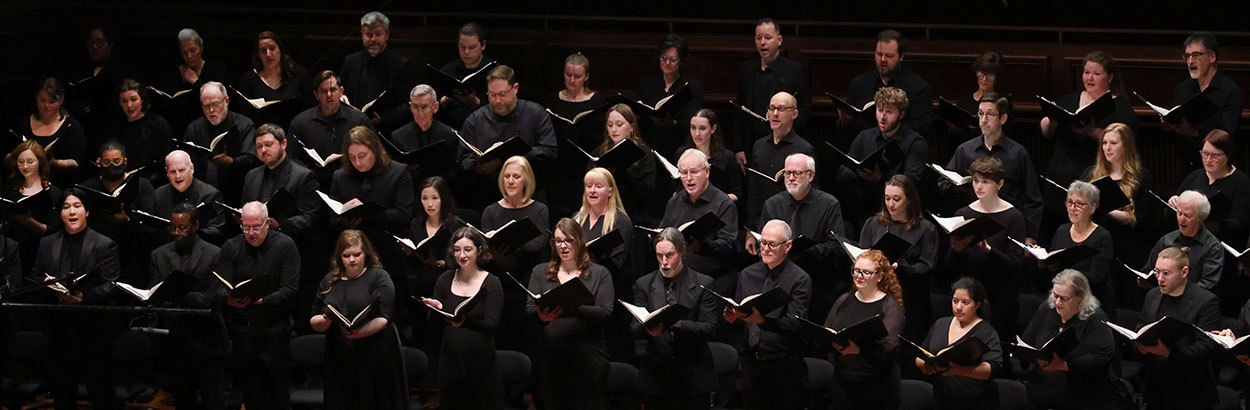
The chorus has a central role to play in the Milwaukee Symphony’s upcoming performances of Bach’s St. Matthew Passion, and Frazes Hill, the chorus director, says that her job is “a combination of being organized and spending a lot of time with the dramatic elements of the piece.”
Written for performance in Bach’s home church on Good Friday in 1727, the Passion is a word-for-word setting of the Gospel of Matthew’s account of Jesus’s arrest, trial, and death. The biblical narration is also interspersed with solo arias and chorales that reflect on what the story means for the listener.
The choir plays double duty in the piece. It is a character, singing the lines of the disciples, the priests, the mob, and any other group of people, but its chorales also provide a moment to stop and reflect.
Frazes Hill has tried to teach the chorus their role in the drama, but another challenge is to take a fresh look at the chorales. Many of the tunes are familiar to singers and audiences from church hymnals, but she wants the chorus both to sing them as if they were unfamiliar and to understand the relations between them.
Flipping through the score — “I think I sleep with it under my pillow,” she joked — she points out a sequence in Part I where the same tune is used two movements apart, but in a key half a step lower the second time. And Music Director Ken-David Masur plans to take the second time louder and faster. “I’ve spent so much time reminding them,” she says, “because it’s easy to go into automatic mode — what is Bach trying to communicate here?”
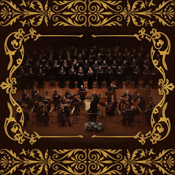
Bach wrote the St. Matthew Passion for a double chorus, but in some ways, Frazes Hill is taking that idea a step farther. When the MSO performs the work at the Bradley Symphony Center, about 70 singers, divided into two choruses, will share the stage with the small (by modern standards) orchestra. But the remaining 60 singers of the Milwaukee Symphony Chorus will be seated in the choral terrace behind the stage, where they will sing the chorales and the large movements that frame the action.
It is customary nowadays to perform Bach with a smaller choir, but Frazes Hill wanted the entire chorus to have the experience of singing the work, which the MSO has not performed since 2002. The solution of splitting into stage and terrace groups got Masur’s backing, and “we really thought it was a good choice,” Frazes Hill said. “It’s very doable and it gives everyone a chance. They’re showing up and they’re doing their homework. They’re really seeing the light now.”
Usually, the conductor only joins the chorus rehearsals in the final week, but Frazes Hill said that Masur has attended three rehearsals over the past two months. As a native of Leipzig, where Bach composed most of his sacred music, he grew up soaked in the city’s musical culture. “Doing Bach with Ken is a very rewarding experience,” Frazes Hill said. “He has such a personal relationship with the piece, and that is infectious.”
Frazes Hill has participated in several St. Matthew Passion performances as a singer and assistant director, but this is her first time being responsible for the entire choral preparation. She started serious work last summer, making charts of rehearsal time and estimating the difficulty of each movement, and planning for the chorus to be coached in the German diction that might be unfamiliar to them.
Bach and Handel were both born in 1685, and Handel’s Messiah, another popular oratorio with a sacred theme, appeared only 15 years later. The difference between the two great works, Frazes Hill said, is that the Passion invites listeners in to be a participant in the story. It reminds people that “what is happening is relevant to our lives today, whatever religion personally you may have. It’s a story about injustice.” The arias and chorales, she said, are “Bach’s way of saying ‘here’s how you should be thinking about this.”