Reaching for the Stars: Student Soloists in Their Own Words
David Lewellen
PUBLISHED
Tagged Under: 2025.26 Season, Education, Stars of Tomorrow
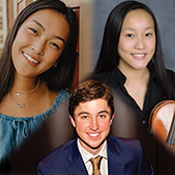
A youthful trio of finalists will perform with the Milwaukee Symphony at the annual Audrey G. Baird Stars of Tomorrow concert.
The program, which stretches back more than 50 years, is open to students in grades 9-12, but this year’s winners include a freshman and two sophomores.
Rebecca Whitney, the MSO’s director of education, said that 32 students auditioned this year for the chance to perform as soloist with the symphony at the April 12 concert. Students who earned semifinal status or honorable mention get the opportunity to perform side-by-side with the MSO’s musicians on the second half.
The orchestra’s calendar allowed this year’s concert to be performed on a Sunday afternoon instead of a weeknight, which may draw better attendance from friends and family members, Whitney said. And since the orchestra moved into its own home at the Bradley Symphony Center, it has been a thrill for students and families to experience the orchestra’s ornate home grounds.
Almost every orchestra offers a youth concerto competition, Whitney said, but “the side-by-side is not so common. We hear from the kids what a wonderful opportunity it is to sit in the orchestra and learn from our musicians.”
The first half of the concert comprises the three finalists performing their concerto movement. The judges decide on a winner during intermission, and following the announcement, the symphony plus 19 student musicians will perform Rimsky-Korsakov’s Capriccio espagnol and Stravinsky’s suite from The Firebird.
Finalist Johana Kim, a sophomore at Homestead High School in Mequon, was an honorable mention last year, which earned her the chance to play the side-by-side portion of the concert. “It was a really great opportunity to sit next to such advanced professional musicians,” she said. Watching MSO flutist Jenny Bouton, Kim noticed that “she played with so much confidence, and she was able to give advice easily. It really helped.”
When she learned that she had advanced to the finals this year, she said, “I was in shock. I was expecting another honorable mention.” At the concert, she will perform François Borne’s fantasy on themes from Bizet’s Carmen for flute.
Kim is thinking about a double major in college, because “flute is too big a part of myself to let go,” she said. “Music is an essential part of life. It makes people happy.”
The other two finalists both play violin. Malina Zhang, a sophomore at Neenah High School, made her first trip to the Bradley Symphony Center earlier this year to see international star violinist Augustin Hadelich solo with the MSO. “It was exciting to see a famous violinist in person,” she said, “and the orchestra sounded really together and they matched each other.”
Zhang will perform Zigeunerweisen, a virtuoso showcase by Sarasate. But aside from technique, she said, “it’s dramatic and emotional, and I have to change my sound and character very quickly.”
She has performed the piece before, and it feels familiar now. “When I play a piece for the first time is when I get the most nervous,” she said. “Once I’m onstage, I remind myself that the audience is just there to listen to the music.”
Colette Wiering, a home-schooled ninth grader from Two Rivers, plays in the Milwaukee Youth Symphony Orchestra, and her parents also drive her to Chicago weekly for lessons with Chicago Symphony Orchestra violinist Matous Michal.
She will perform the third movement of the Dvořák violin concerto, and said, “It’s technically very challenging, but it’s joyful and folky and dance-like. I always feel really happy when I play it.”
When the big day comes, she said, “I try not to focus on the competition. I want to feel good about what I’ve accomplished with the piece, and I want to enjoy playing in the Bradley Symphony Center with the Milwaukee Symphony.” She also looks forward to the second half of the concert, when she can sit in the audience and cheer for her friends who are playing the side by side.
Students benefit from the opportunity to raise their game, but the process also helps the orchestra, too. “The young talent always blows me away,” Whitney said. “And it’s good for us in the long run. It helps the kids understand what goes into the craft, and it’s building audience members of the future, too.”