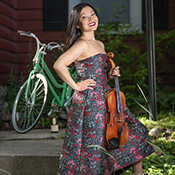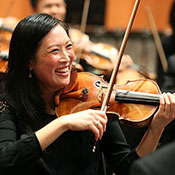

MSO Musician Spotlight: Autumn Chodorowski
David Lewellen
PUBLISHED
Tagged Under: MSO Musicians, Violin
An outstanding violinist needs an outstanding violin.
But good instruments cost money, and Autumn Chodorowski, who recently finished her second year in the Milwaukee Symphony Orchestra’s first violin section, is open about the obstacles that a young musician faces. “Sometimes equipment holds you back,” she says.
Eighteenth century instruments from masters like Stradivari and Guarneri now sell for millions of dollars, and violinists who are lucky enough to play them almost always get them on loan from foundations or private investors. But top-of-the-line instruments from modern makers can cost as much as a house or a car, which is almost equally out of reach for most musicians starting a career.
When Chodorowski went shopping for a new violin, she visited several prominent luthiers across the country. At Robertson and Sons Violin Shop in Albuquerque, she found a new instrument whose sound she loved, but the neck was too thick. Nervously, she asked if they could shave it down. They did, and it felt more comfortable and opened up the sound. And the price was a bargain.
She had been saving for a while for a new instrument, and with the help of a loan from her parents, she was able to make the purchase. But she quickly points out that not everyone is as fortunate.
“My old violin did get me into Tanglewood and all the festivals,” she says, but with the new one, she began advancing in auditions for full-time jobs, and finally she won the Milwaukee position in the spring of 2024.
She has kept her old instrument as a backup, which not everyone does. (Brass and woodwind players tend to accumulate a larger collection, which may be related to the fact that those instruments generally cost less.)
Now, she is in the market for a new bow, which is harder than shopping for a violin. “It’s more about personal feel” and fitting the instrument she already has, she says. Is it like the wand choosing the wizard in the Harry Potter stories? “Kind of,” she says with a laugh. “I wish there would be sparks shooting out of the right one.”
Chodorowski grew up in northern Illinois and studied violin with her mother from age three until high school. “Neither of us recommend that,” she says with a smile. “My mom wasn’t going to pay money for lessons until I took it seriously.” But a great summer music camp convinced her that she wanted to pursue music as a career, and she studied at the Glenn Gould Conservatory in Toronto and at Northwestern University.
She has always had a passion for chamber music, but she found it was an even harder way to make a living than winning an orchestra audition. “You have to find three other people at the right place and time who share your mindset,” she says.
Once she began taking auditions, she earned a spot in the prestigious New World Symphony training orchestra in Miami, as well as principal second violin in the Quad Cities Symphony in western Illinois and eastern Iowa. Playing in two orchestras a thousand miles apart is possible “if you’re smart and responsible and request time off far in advance,” she says.
Chodorowski has found little time to play in small groups in Milwaukee, partly because of her travel schedule; her husband, Brendan Fitzgerald, plays bass in the St. Louis Symphony Orchestra. The two of them get to be together full-time for July and August at the Sun Valley Music Festival in Idaho. For the rest of the year, she recently bought a house in Cudahy and spends her spare time working on it. She also enjoys reading and kayaking.
Last year, she was elected to a seat on the MSO Players’ Council, which is responsible for the musicians’ contract and working conditions. “I’m new and young and fresh,” she says. “Everyone here has been so welcoming and open, and I felt I clicked really fast.”
She enjoys her position in the back of the first violin section. “You have more power in the back,” she said. “If the back is playing louder, the people in the front will hear that and feel more comfortable leaning in to a crescendo. The whole section will try to meet you and collaborate.” And if everyone is listening to everyone else, “it leads back to chamber music.”