A Note from the Director: Bill Barclay on Copland & Twain
Bill Barclay
PUBLISHED
Tagged Under: 2025.26 Season, Bradley Symphony Center, Guest Artist, Special Presentation
This program began by imagining how to publicly go about celebrating America’s 250th anniversary. How could this event serve such a polarized time in our history? I have always been moved by some of the traditional American tunes and hymns, but the state of our country called for something else, something I couldn’t quite identify at first.
I now realize that for some reason or other, I wanted to laugh. I wanted to release energy, not summon it. I wanted the community of joy, not the burden of politics. And it seemed that avoiding politics entirely was ignoring the elephant in the room.
A symphony audience today may be one of the last public spaces of American life that is truly politically heterogeneous. Classical music plays to Republicans, Democrats, and Independents alike. This prompts a follow-up question: is there a way we can laugh about ourselves without excluding people?
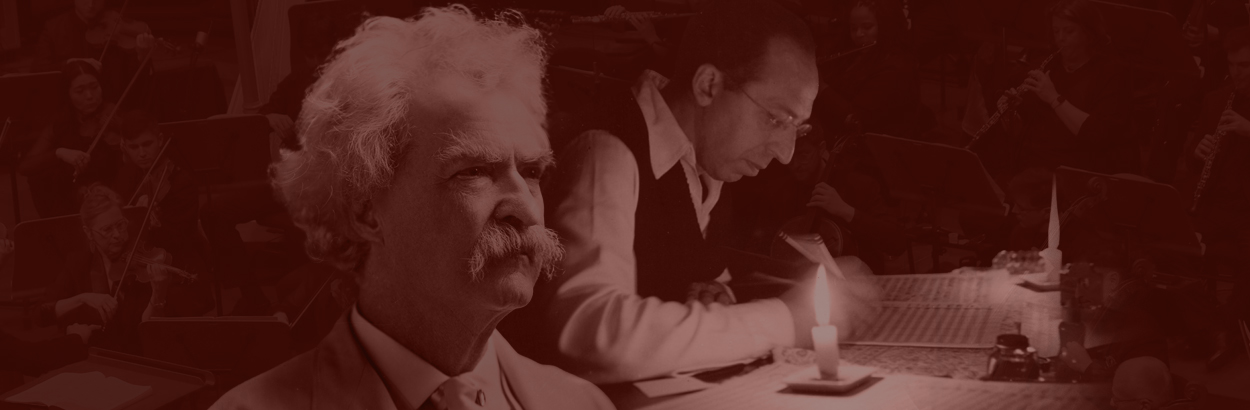
Today, Mark Twain seems as mainstream as apple pie, but during most of his life, he lived the life of a tramp. Both a free-wheeling populist and a cunning intellectual, his brand of satire made him the first true American celebrity. He also left behind a voluminous body of largely forgotten work, writing every week of his adult life. I took the opportunity of this anniversary to read some 2,000 pages of apocryphal speeches, articles, toasts, diary entries, and humorist essays that I had never even heard about before. I wanted to look beyond the author of Huckleberry Finn and summon his faith in America from beneath the quips. The richness of this corpus, and its resemblance to the ills that still plague us today, is simply uncanny.
Aaron Copland is often called The Dean of American Music, and it’s not hard to understand why. His long life (1900 – 1990) witnessed several profound changes in American identity. Yet however closely we associate him with the establishment in retrospect, his actual lived experience — like Twain’s — ran largely counter to that image. He was hauled before the House Un-American Activities Committee in 1953 as a suspected communist. He was blacklisted for his leftist associations and, in other chapters of his life, marginalized for his homosexuality. His musical pivots away from the tonality that made him famous and into the serialism of Arnold Schoenberg further cemented his outsider persona during his lifetime.
Today we present two distinctively American artists, mutually holding up core pillars of our identity, who need to be unpolished before authenticated. Their bodies of work cry out for a robust re-examination, and what else is an anniversary for? I take two of Copland’s lesser-known suites, Music for Movies and Music for the Theatre, and restore them to their incidental roots, while sharing with you some of the gems collected from dozens of Twain’s most colorful passages that history has forgotten. More surprises await after the intermission.
It is a theatrical concert that I deeply believe both men would have loved.