From Genoa to Jazz: Giuseppe Gibboni in Profile
David Lewellen
PUBLISHED
Tagged Under: 2025.26 Season, Guest Artist, Violin
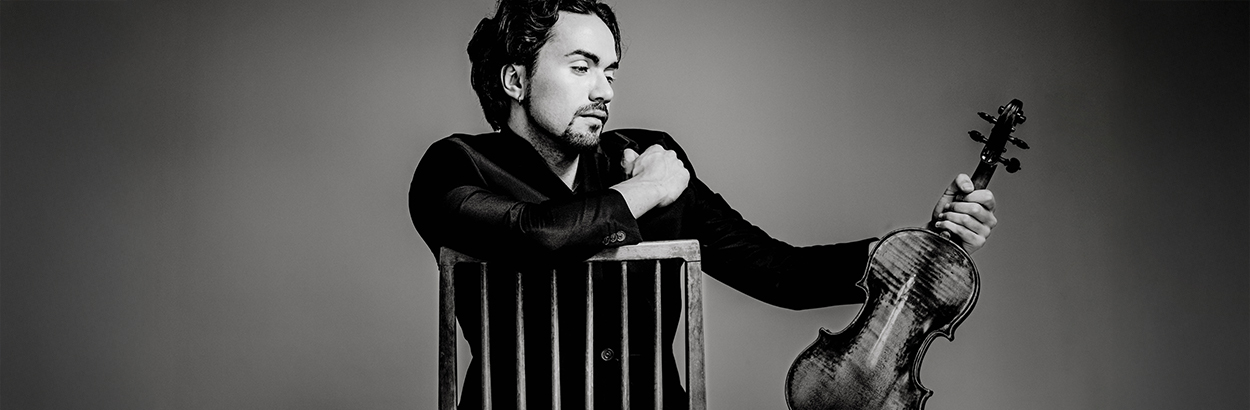
For Giuseppe Gibboni, raised in the rich tradition of Italian violin playing, the sound world of Wynton Marsalis was a stretch.
But Gibboni, quickly building a career as an in-demand soloist, was game to expand his horizons, and Milwaukee Symphony Orchestra audiences will see the results May 29-30, when he performs Marsalis’s violin concerto at the Bradley Symphony Center.
“It’s a fantastic concerto, very different, and also difficult,” Gibboni said recently by phone from Italy. “It’s very intricate musically, with a lot of effects and styles, and you need to understand that world.”
Marsalis is most famous as a jazz trumpet player, but he has regularly crossed over to write for classical ensembles, and his violin concerto premiered in 2015. Jader Bignamini, who will conduct the Milwaukee concerts, is also the music director of the Detroit Symphony Orchestra, where he and Gibboni performed the Marsalis piece last fall.
Learning to play in the style of an American jazzman was “very challenging,” Gibboni said. “I loved to do it, and I can learn a lot from that kind of music. I listened to a lot of jazz, and I discovered that I really like jazz.”
Marsalis’s score marks a couple spots for the soloist to improvise, which is unusual in modern classical music. It ends on a slow, soft passage, and in Detroit, Gibboni actually left the stage while playing the last phrase. “The audience loved it,” he said. “Concertos tend to finish like an explosion, but this was a very relaxed finale. It was like a jazz club.”
Overall, Gibboni said, “We need a little more freedom in classical music today.” He mentioned the norms of past centuries when people talked and ate throughout the concert, and he said, “When people clap between movements, it’s natural. I don’t mind.” And the last movement of the Marsalis piece, titled “Hootenanny,” begins with the orchestra clapping and stomping.
Born and raised in Italy, Gibboni won the Paganini International Violin Competition in Genoa in 2021 at age 20, and “my life totally changed,” he said. “I’m still learning to deal with the work of classical music.” Things like travel logistics and blocking off practice time on the road are “something no one teaches you in school,” he said. “Today with social media, everything is different. We’d like to focus just on music, but there are a lot of things to know.”
Because he won a concerto competition, most of Gibboni’s engagements have been with orchestras as a soloist, although he recently completed a recital tour. “My goal is to play more chamber music,” he said, but that requires finding several other musicians and aligning their schedules.
Until recently, Gibboni had the long-term loan of two Stradivarius violins from two foundations — vintage instruments are now so expensive that almost no musicians can afford to buy one. “It was a big responsibility to have both,” he said, “but I didn’t want to keep everything for me.” He has returned the 1722 instrument known as the “Jupiter” to the Nippon Foundation and continues to play the 1734 “Lam; Ex-Scotland University,” on loan from the CCI Foundation of New York.
The differences between the two are hard to explain, he said, but “it’s like when you find your partner.”
Instruments that are 300-plus years old need to be handled and played more carefully, of course, but Gibboni said there are real advantages to the sound, as well as the intangible weight of heritage. “You feel the experience of the musicians who played this instrument,” he said. “Antonio Stradivari was famous in his own lifetime, so he was making instruments for the big musicians of the time.”
But, he added, “I’m also a big fan of the modern instruments. I have a modern instrument by Luiz Amorim that I love, and very often I play it onstage. But the old instruments have colors that are really magical, and I’m more free to play and discover.”